Most small businesses that come to us after a bad fit with another accounting firm picked that firm on price. We've onboarded more than 150 clients since 2015 , and we see the same story again and again. The lowest monthly quote wins. Six months later, the owner is paying a second team to clean up miscategorized transactions and accounts nobody reconciled, and they're back to feeling stressed and reactive about their numbers.
So how do you choose an outsourced accounting firm that actually fits? Start by deciding what level of help you need. Then check each firm's credentials, industry experience, software fit, data security, reporting habits, and pricing model to find the best outsourced business and financial accounting firms, and get the full scope in a written engagement letter before you sign.
We use this same checklist when we talk with prospective clients, and as an outsourced accounting firm like Accountix Solutions, we expect owners to hold us to it too. Below is the step-by-step process, a scorecard for weighing firms side by side, and our take on what separates the best outsourced business and financial accounting firms from everyone else.
TL;DR Quick Answers
Best Outsourced Business and Financial Accounting Firms
The best outsourced business and financial accounting firms match your current stage and put every commitment in writing, so you get clear, decision-ready numbers each month. Look for a firm that:
Offers bookkeeping, outsourced accounting, and fractional CFO support, so it can grow with you
Has a licensed CPA reviewing the work, which you can verify through CPAverify
Already serves businesses in your industry
Works in your existing software and leaves you owning the accounting file
Names your contact, sets a monthly close date, and quotes a fixed fee in a written engagement letter
Choose on fit first and price last. That's how owners move from stressed and reactive to structured and strategic.
Top Takeaways
Match the firm to your stage, whether that's bookkeeping, outsourced accounting, or a fractional CFO.
Look up CPA licenses and preparer credentials yourself rather than trusting a website badge.
Industry experience shortens onboarding and catches errors specific to your sector.
A fixed monthly fee with a written scope usually beats a low hourly rate.
Your engagement letter protects you more than any sales call.
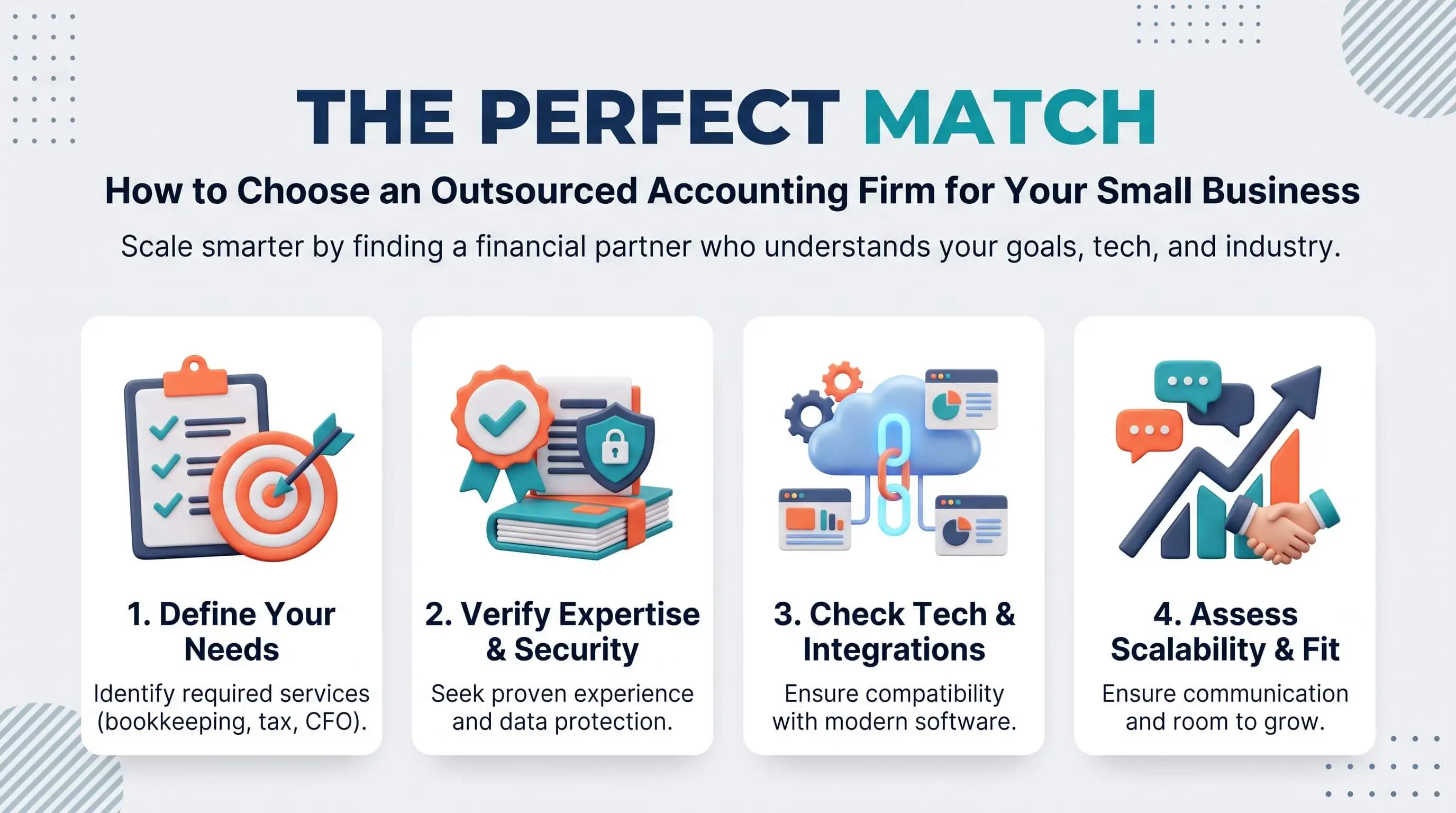
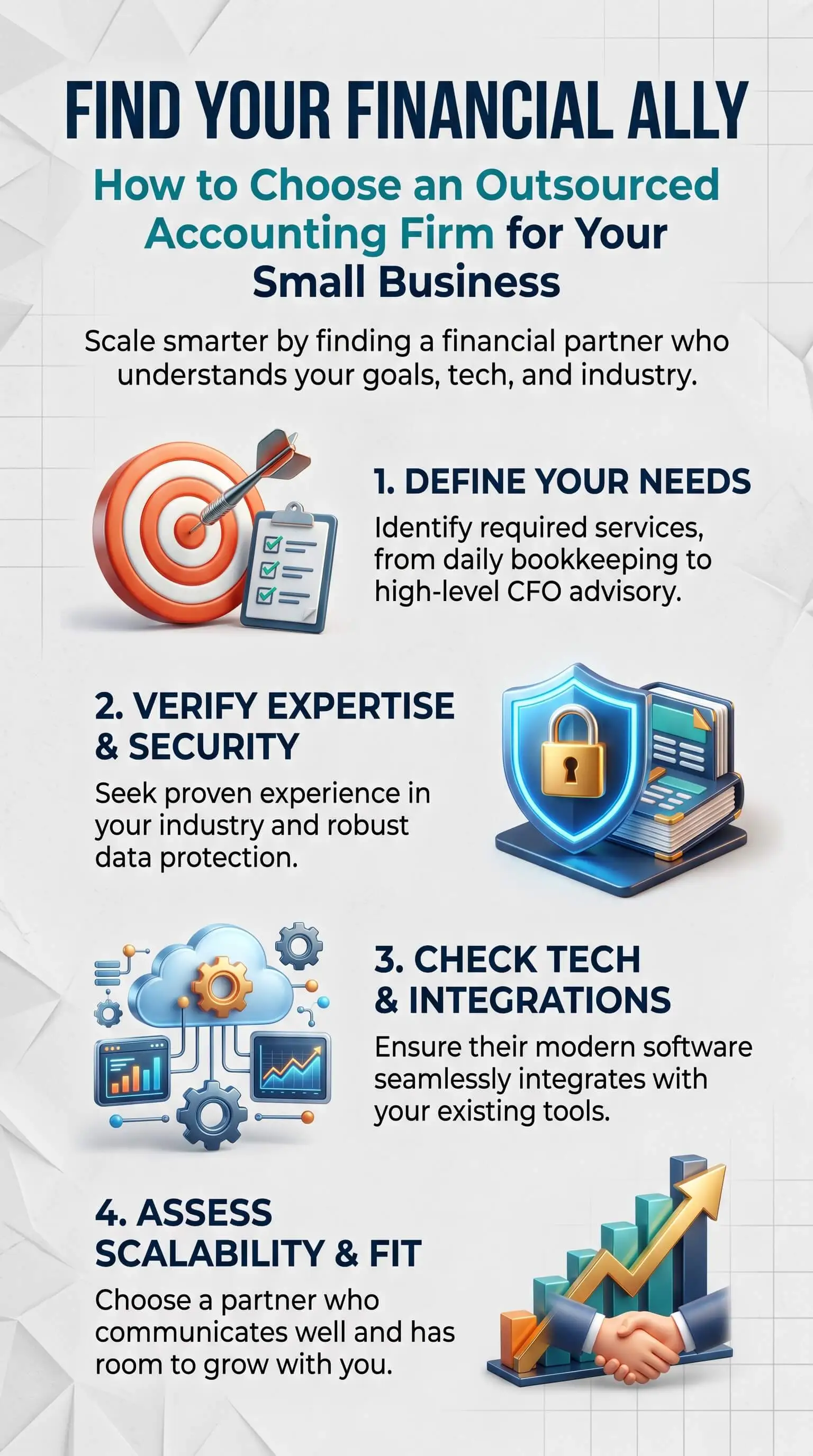
How to Choose the Right Outsourced Accounting Firm for Your Small Business
Eight checks separate a good fit from an expensive mistake. Work through them in order, since each one narrows the field for the next.
1. Define the Level of Support You Need
Bookkeeping, outsourced accounting, and fractional CFO support are different services at different price points. Each builds on the one below it, and paying for the wrong tier wastes money in either direction.
Bookkeeping: Covers transaction entry, categorization, bank and card reconciliations, and basic monthly reports. It usually fits businesses under about $2 million in annual revenue . You probably need it if you're behind on your books or catching up on them at night.
Outsourced accounting: Adds AP/AR workflows, payroll integration, the monthly close, internal controls, and performance reporting on top of bookkeeping. It usually fits growing businesses in the $1 million to $3 million range . Late reports, or a month-end close nobody owns, are the usual signals.
Fractional CFO: Brings forecasting, budgeting, cash flow strategy, pricing and hiring decisions, and support with lenders and investors. It suits growing businesses facing big financial calls. If you have numbers but no plan for using them, this is the tier to look at.
Plenty of owners need bookkeeping today and CFO-level guidance a year or two from now. If that's you, look for a firm that offers all three so you can grow without switching partners. You can read more about what a fractional CFO actually does for a growing business.
2. Verify Credentials and Who Does the Work
A badge on a website proves nothing, so look the license up yourself. State boards of accountancy license certified public accountants (CPAs), and NASBA's free CPAverify database lets you check a license's status quickly. If the firm will prepare your federal tax returns, the IRS requires every paid preparer to hold a Preparer Tax Identification Number (PTIN).
Then ask the question most owners skip. Who will actually handle my books? A U.S.-based accountant, an offshore team, and software with a human reviewer can all work, but you deserve a straight answer about which one you're paying for.
3. Look for Experience in Your Industry
Industry experience decides how fast onboarding goes. A contractor needs job costing. A nonprofit needs fund accounting and grant reporting, and a creative agency needs profitability tracked project by project. A firm that already serves businesses like yours will catch problems a generalist would miss.
4. Confirm Software Fit and Data Ownership
Your firm should work inside the tools you already use or give you a clear reason to switch. Ask about QuickBooks Online or Xero, bill pay, payroll, and bank feeds. One point isn't up for negotiation. Your business owns the accounting file, and you keep admin access to it at all times.
5. Ask How Your Financial Data Is Protected
Any firm worth hiring can explain its security in plain English. Listen for multi-factor authentication, role-based access, encrypted cloud software, and a written data-handling policy. If the firm also prepares tax returns, ask whether it follows IRS Publication 4557, Safeguarding Taxpayer Data.
6. Set Expectations for Communication and Reporting
Good firms are predictable. You should know your point of contact by name, how quickly they reply, and the date your books close every month. Each month, expect a profit and loss statement, a balance sheet, and a cash flow statement, along with a short note on what changed.
7. Compare Pricing Models, Not Just Prices
The cheapest quote often turns into the most expensive relationship. Most firms bill in one of these ways:
Hourly: Flexible, though hard to budget around
Monthly retainer: Bundled services for a predictable fee
Tiered packages: Set levels such as bookkeeping, accounting, and CFO oversight
For reference, bookkeeping at Accountix Solutions starts at $200 per week, and full outsourced accounting typically runs $1,500 to $8,000 per month depending on size, complexity, and service level . Whatever number a firm quotes you, ask what triggers extra charges. Catch-up work, additional entities, and tax filings are the add-ons we see most often.
8. Get the Scope in a Written Engagement Letter
Your engagement letter protects you far more than anything said on a sales call, so read it closely. Before you sign, confirm it spells out:
Which services are included and which aren't
Deliverables and monthly deadlines
Fees and what changes them
Who owns the data and how the firm returns it if you leave
Termination terms and the notice period
What Separates the Best Outsourced Business and Financial Accounting Firms
Size and list rankings tell you very little. What sets the strongest firms apart is fit, backed by accountability they're willing to put in writing. Score up to three firms from 1 to 5 on each criterion below, then multiply each score by its weight.
Service fit for your stage (20%): Offers your tier now and the next one up.
Credentials and oversight (20%): A licensed CPA reviews the work, and you can verify the license.
Industry experience (15%): Serves current clients in your sector.
Technology and data ownership (15%): Works in your stack and leaves you owning the file.
Security (10%): Uses MFA, keeps a written policy, and discloses its staffing model.
Communication and close timeline (10%): Names your contact and commits to a close date in writing.
Pricing clarity (10%): Charges a fixed fee with the exclusions listed.
Red Flags to Watch For
The firm won't put the scope of work in writing
Nobody can tell you who your point of contact will be
Answers about who handles your data, and where, stay vague
Billing is hourly only, with no estimate
The firm hesitates when you ask for client references
Questions to Ask Before You Sign
Who will work on my books day to day?
What date will my books close each month?
What does the monthly report package include?
What isn't included in the fee?
How do you handle catch-up or cleanup work?
Can we move up to a higher service level later?
What happens to my data if we part ways?
"When we onboard a new client, we look at how their numbers got there before we look at the numbers themselves. Most of the businesses that come to us after a bad fit had books that looked tidy on the surface, with months of unreconciled accounts and misfiled expenses underneath. Good accounting should tell an owner the truth about their business. If your firm can't explain your reports in plain English, or can't tell you when your books will close, the fit is the problem, not your business. Every partnership we've seen work well started the same way, with a clear scope and a monthly rhythm the owner could count on."
Essential Resources
These seven resources will help you ask sharper questions and check what a firm tells you. Each one comes from a government agency, a professional licensing body, or a small business organization we trust.
SBA Guide to Managing Your Business Finances: Learn the Basics Before You Delegate. The U.S. Small Business Administration walks through balance sheets, cash vs. accrual accounting, and the core tasks someone on your side needs to own, like AP, AR, and bank reconciliations. https://www.sba.gov/counseling/manage-your-business/
NASBA CPAverify: Confirm a CPA License in Seconds. State boards of accountancy feed this free national database, which shows whether a CPA or firm holds an active license in good standing. https://www.nasba.org/licensure/cpaverify/
IRS Tips for Choosing a Tax Professional: Spot the Red Flags Early. The IRS explains why every paid preparer needs a valid PTIN and which warning signs mean you should look elsewhere. https://www.irs.gov/newsroom/irs-take-care-when-choosing-a-tax-return-professional
IRS Publication 4557: Know What Data Protection Should Look Like. The IRS guide to safeguarding taxpayer data gives you a real standard to measure a firm's security practices against. https://www.irs.gov/pub/irs-pdf/p4557.pdf
IRS Small Business and Self-Employed Tax Center: Understand Your Tax Obligations. Get clear on your federal filing responsibilities before you decide which ones to hand off. https://www.irs.gov/businesses/small-businesses-self-employed
SCORE 12-Month Profit and Loss Projection: See Where Your Numbers Are Headed. SCORE's free template helps you forecast income and expenses, and it makes a useful baseline to share with any firm you interview. https://www.score.org/templates/12-month-profit-and-loss-projection/
U.S. Chamber of Commerce CO—: Recognize When It's Time to Outsource. This guide covers the signs you've outgrown DIY accounting and what to look for in an outside firm. https://www.uschamber.com/co/run/finance/signs-you-should-outsource-your-small-business-accounting
These trusted resources can help you evaluate an outsourced accounting firm by checking its credentials, tax knowledge, data security, financial processes, and overall fit for your business.
Supporting Statistics
The federal data below lines up closely with what we see in our own client work.
Small Businesses Carry the U.S. Economy
The SBA Office of Advocacy reports that 99.9% of U.S. businesses are small. That's more than 36.2 million firms, generating 43.5% of GDP.
Most of those businesses carry that weight without a finance department behind them. An outsourced accounting firm fills exactly that gap.
Source: SBA Office of Advocacy, Frequently Asked Questions About Small Business 2026
The First Year Is the Hardest
One-year survival rates for new business establishments born in 2022 ranged from 74.4% to 78.6%, depending on the region. Roughly one in four didn't make it through year one.
Many of the owners we onboard are still in those early years. Clean books and a reliable monthly close help them catch problems while they're still fixable.
Source: U.S. Bureau of Labor Statistics, 1-Year Survival Rates for New Business Establishments
Rising Costs Are Squeezing Small Firms
Small employer firms in the Federal Reserve's 2025 Small Business Credit Survey named rising costs of goods, services, and wages as their most common financial challenge. More than four in 10 also cited higher costs tied to tariffs, and 77% reported one or both.
Tight margins demand accurate numbers, fast. In our experience, the businesses that handle cost pressure best already know their true margins before it hits.
Source: Federal Reserve Banks, 2026 Report on Employer Firms
Final Thoughts and Opinion
Picking an accounting partner has less to do with finding the top name on a list than with finding the right fit for where your business stands today.
Here's what we've seen across our client work:
Owners rarely regret paying for a clear scope, but they often regret choosing on price alone.
Credentials only protect you if you verify them yourself.
A predictable monthly close does more for your decisions than any one-time cleanup.
The right firm grows with you, from bookkeeping now to CFO-level strategy later.
We believe the best outsourced business and financial accounting firms earn trust with a clear written scope, expertise you can check, and reporting that shows up on time and makes sense for businesses and independent schools. Price belongs at the end of your evaluation. Get the fit right, and your books become a tool you actually use instead of a source of stress.
Q: What does an outsourced accounting firm do for a small business?
A: It runs your financial operations so you don't have to hire in-house staff. That usually means bookkeeping, reconciliations, accounts payable and receivable, payroll coordination, the monthly close, and financial reporting. Some firms also offer fractional CFO strategy.
Q: How much does outsourced accounting cost?
A: The price depends on your transaction volume, complexity, and service level. Bookkeeping-only support can start at a few hundred dollars a week, and full outsourced accounting typically runs $1,500 to $8,000 a month . Always ask what the fee leaves out.
Q: Is outsourced accounting worth it for a small business?
A: For most small businesses, yes, especially once the owner starts spending evenings on the books. You get professional accounting for less than the cost of one full-time hire , and you can add support as you grow.
Q: What's the difference between a bookkeeper, an accountant, and a fractional CFO?
A: A bookkeeper records and reconciles transactions. An accountant adds the monthly close, controls, and reporting. A fractional CFO takes that data and uses it to guide forecasting, pricing, hiring, and funding decisions.
Q: Should my outsourced accounting firm be a CPA firm?
A: Not necessarily, but you want a licensed CPA reviewing the work or on hand for tax and compliance questions. Check any CPA's license through CPAverify or your state board of accountancy.
Q: Can I switch accounting firms mid-year?
A: Yes. A good firm handles the transition for you, catch-up work included. Before you switch, confirm that you own your accounting file and can export your records.
Ready to Find the Right Accounting Partner?
Your books don't need to be perfect before you start the conversation. Here's how to move forward this week:
List the financial tasks that eat up most of your time.
Shortlist three firms and verify their credentials.
Score each one with the scorecard above.
Ask every firm for a sample engagement letter, then compare them side by side.
Book a short intro call with your top choice.
Wondering whether you need strategic support on top of clean books? Our fractional CFO services guide explains what that next level looks like.
If you'd like a second opinion on your current setup, schedule a 30-minute intro call with Accountix Solutions. No sales pitch. Just a clear look at where your finances stand and the kind of support that fits.