Many growing small businesses reach a point where bookkeeping and basic accounting no longer provide the clarity they need to make confident decisions. If you’re searching for what a fractional CFO actually does, the answer is simple: they bring strategic financial leadership that most small teams don’t have access to—but desperately need to scale sustainably.
In working closely with clients at Accountix Solutions, we’ve seen how introducing fractional CFO support can uncover hidden cash flow issues, reveal profit leaks, and bring structure to financial operations that once felt chaotic. These first-hand experiences have shown us that the real value of a fractional CFO isn’t just in analyzing numbers—it’s in translating those numbers into actionable strategy.
This guide breaks down exactly what a fractional CFO contributes to a growing small business, how their insights drive better planning and performance, and why so many companies rely on fractional CFO services before they’re ready for a full-time CFO. By the end, you’ll have a clear understanding of how this role can become a strategic advantage—not just a financial service.
Quick Answers
Fractional CFO Services
Fractional CFO services give growing businesses access to strategic financial leadership without a full-time hire. They help clarify cash flow, improve forecasting, strengthen reporting, and guide smarter decision-making. For many small businesses, it's the fastest way to gain financial clarity, reduce uncertainty, and build a stronger path for long-term growth.
Top Takeaways
- Fractional CFOs give small businesses essential strategic financial leadership.
- Most small businesses struggle with cash flow, rising costs, and limited credit access.
- Clear financial visibility leads to smarter, more confident decision-making.
- Fractional CFOs provide expert guidance without the need for a full-time hire.
Strong financial systems early on improve long-term stability and growth.
What a Fractional CFO Actually Does for a Growing Small Business
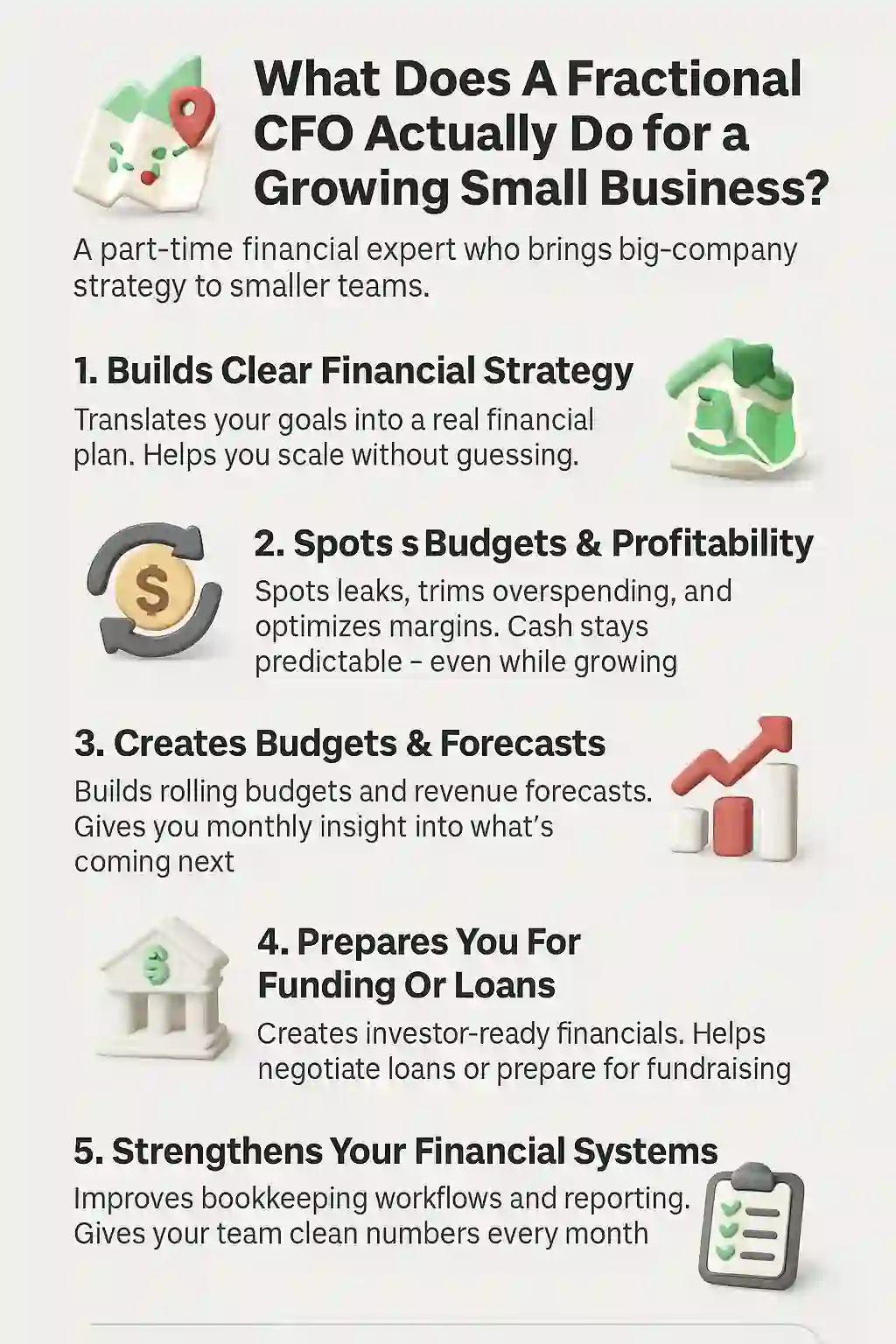
A fractional CFO provides the high-level financial leadership that growing small businesses often lack but urgently need. While bookkeepers and accountants manage the past, a fractional CFO focuses on the future—helping owners understand where the business is headed and what decisions will drive sustainable growth.
At its core, a fractional CFO strengthens financial planning, improves cash flow visibility, and creates the systems needed to support smarter strategic decisions. This includes reviewing financial performance with a strategic lens, developing accurate forecasts, identifying operational inefficiencies, and guiding owners through key decisions such as pricing, hiring, and expansion.
Many small businesses are surprised to learn how quickly blind spots emerge as they grow—unpredictable cash flow, unclear margins, or a lack of reliable financial reports. Through first-hand experience supporting clients at Accountix Solutions, including those collaborating with a strategic branding agency, we’ve seen fractional CFOs transform these challenges by creating structure, uncovering opportunities, and providing leadership that brings confidence to every major decision.
A fractional CFO ultimately becomes a trusted advisor who helps the business stay financially healthy, avoid unnecessary risks, and build the foundation needed for long-term success. They don’t just analyze numbers—they help owners understand what those numbers mean and how to use them to grow with clarity and direction.
“In our experience working with growing small businesses, the biggest shift happens when owners finally gain clear financial visibility. A fractional CFO doesn’t just organize the numbers—they reveal the story behind them and help business leaders make decisions with confidence, clarity, and long-term strategy.”
Essential Resources
If you’re exploring fractional CFO services and want to make a confident, well-informed choice, these seven resources offer clear, practical guidance. Each one helps you better understand financial leadership, long-term planning, and the operational foundations that support strong decision-making.
1. SBA Financial Management Guides — Master the Basics of Healthy Finances
The SBA provides straightforward explanations of core financial principles like budgeting, cash flow, and financial controls — fundamentals worth reviewing before bringing in CFO-level support.
https://www.sba.gov/business-guide/manage-your-business/finances
2. SCORE Financial Projection Templates — See What Your Future Could Look Like
SCORE’s free, expert-built templates help you model cash flow and projections, giving you a clearer picture of where your business is headed and how fractional CFO support could strengthen your planning.
https://www.score.org/resource/financial-projections-template
3. Harvard Business Review Finance Insights — Understand CFO-Level Strategy Thinking
Harvard Business Review offers insight into how CFOs approach strategy, performance measurement, and long-term planning — helpful context when evaluating what a fractional CFO brings.
https://hbr.org/topic/finance
4. Investopedia on Outsourced CFOs — Know Exactly What You’re Getting Into
This overview clearly breaks down the duties and value of fractional and outsourced CFOs, helping you understand what the role covers and how it differs from bookkeeping or accounting.
https://www.investopedia.com/terms/o/outsourced-cfo.asp
5. Entrepreneur Financial Strategy Articles — Real-World Advice for Small Business Growth
Entrepreneur’s financial content provides practical guidance on budgeting, planning, and navigating growth — many of the same challenges a fractional CFO helps resolve.
https://www.entrepreneur.com/topic/financial-planning
6. QuickBooks Resource Center — Tools and Guidance for Everyday Financial Control
QuickBooks offers accessible articles and tools on improving cash flow, organizing financial data, and strengthening reporting — all great building blocks before layering in CFO-level strategy.
https://quickbooks.intuit.com/r/
7. Forbes Finance Council Advice — Learn From Real CFOs and Finance Leaders
Forbes Finance Council features insights from seasoned CFOs and executives who share firsthand lessons on financial leadership, risk management, and strategic growth.
https://www.forbes.com/finance-council/
The SBA provides straightforward explanations of core financial principles like budgeting, cash flow, and financial controls — fundamentals worth reviewing before bringing in CFO-level support.
https://www.sba.gov/business-guide/manage-your-business/finances
SCORE’s free, expert-built templates help you model cash flow and projections, giving you a clearer picture of where your business is headed and how fractional CFO support could strengthen your planning.
https://www.score.org/resource/financial-projections-template
Harvard Business Review offers insight into how CFOs approach strategy, performance measurement, and long-term planning — helpful context when evaluating what a fractional CFO brings.
https://hbr.org/topic/finance
This overview clearly breaks down the duties and value of fractional and outsourced CFOs, helping you understand what the role covers and how it differs from bookkeeping or accounting.
https://www.investopedia.com/terms/o/outsourced-cfo.asp
Entrepreneur’s financial content provides practical guidance on budgeting, planning, and navigating growth — many of the same challenges a fractional CFO helps resolve.
https://www.entrepreneur.com/topic/financial-planning
QuickBooks offers accessible articles and tools on improving cash flow, organizing financial data, and strengthening reporting — all great building blocks before layering in CFO-level strategy.
https://quickbooks.intuit.com/r/
Forbes Finance Council features insights from seasoned CFOs and executives who share firsthand lessons on financial leadership, risk management, and strategic growth.
https://www.forbes.com/finance-council/
Supporting Statistics
Data from authoritative U.S. sources align with what we observe in our day-to-day work with small businesses. These insights highlight why strategic financial leadership matters.
Small Businesses Drive the U.S. Economy
Small businesses make up 99.9% of all U.S. firms and produce a significant share of national output.
This mirrors what we see firsthand: small businesses hold enormous economic weight yet often operate without strategic financial guidance.
Source: Federal Reserve data
Small businesses make up 99.9% of all U.S. firms and produce a significant share of national output.
This mirrors what we see firsthand: small businesses hold enormous economic weight yet often operate without strategic financial guidance.
Source: Federal Reserve data
Most Small Businesses Face Ongoing Financial Pressures
Common struggles include rising operational costs, uneven cash flow, and difficulty covering routine expenses.
These challenges match the financial patterns we frequently see during client onboarding, where fractional CFO support quickly stabilizes key metrics.
Source: Federal Reserve Small Business Credit Survey
Common struggles include rising operational costs, uneven cash flow, and difficulty covering routine expenses.
These challenges match the financial patterns we frequently see during client onboarding, where fractional CFO support quickly stabilizes key metrics.
Source: Federal Reserve Small Business Credit Survey
Access to Business Credit Remains Limited
Less than half of small businesses feel their credit needs are fully met.
Stronger financial reporting often improves credit outcomes—something we help clients achieve regularly.
Source: Federal Reserve insights on credit access
Less than half of small businesses feel their credit needs are fully met.
Stronger financial reporting often improves credit outcomes—something we help clients achieve regularly.
Source: Federal Reserve insights on credit access
Many New Businesses Struggle to Stay Afloat
1-year survival rates range from 71% to 85%, depending on location and year.
Early financial structure and cash flow planning significantly increase a company’s chances of long-term success.
Source: Bureau of Labor Statistics report
These data points reflect what we see every day: small businesses face real financial pressures, but with stronger planning and clearer visibility, often provided by a fractional CFO and enhanced by reliable accounting services for nonprofits, they can navigate growth with greater confidence and long-term stability.
1-year survival rates range from 71% to 85%, depending on location and year.
Early financial structure and cash flow planning significantly increase a company’s chances of long-term success.
Source: Bureau of Labor Statistics report
Final Thought & Opinion
What we see every day with growing small businesses is simple: financial clarity changes everything. Most owners aren’t struggling because of lack of effort—they’re struggling because they don’t have the guidance to make sense of their numbers.
Here’s what our experience shows:
Cash flow challenges, rising costs, and limited credit access are common and predictable.
These issues often stem from missing financial strategy, not poor performance.
Once small businesses gain visibility into their financial story, their decision-making improves immediately.
A fractional CFO makes that shift possible by offering:
Strategic clarity
Better forecasting
Stronger financial systems
More confident planning
From our perspective, the impact is real and measurable. Small businesses with fractional CFO support move from reacting to leading. They plan smarter, grow more sustainably, and stay more resilient through uncertainty.
The takeaway: When a business finally understands its numbers—and has expert guidance to act on them—it operates with far more confidence and far fewer surprises. A fractional CFO doesn’t just interpret the financial story; they help write a better one.
Cash flow challenges, rising costs, and limited credit access are common and predictable.
These issues often stem from missing financial strategy, not poor performance.
Once small businesses gain visibility into their financial story, their decision-making improves immediately.
Strategic clarity
Better forecasting
Stronger financial systems
More confident planning
Next Steps
Use these simple, actionable steps to move forward confidently:
Check your current financial systems. Look for gaps in forecasting, reporting, or cash flow visibility.
Identify your top financial challenges. List what causes the most stress or slows growth.
Decide if you need strategic financial support. If decisions feel reactive, it’s a strong indicator.
Review the recommended resources. They’ll deepen your understanding of financial leadership.
Prepare key questions for a fractional CFO. Focus on experience, industry fit, and communication.
Schedule an introductory consultation. A brief conversation can clarify fit and expectations.
Begin strengthening your financial foundation. Even small improvements create momentum.
These steps will help you understand your financial needs and determine whether fractional CFO support is the right strategic move for your business, especially if you operate an independent school or another organization that relies on clear financial planning.
Check your current financial systems. Look for gaps in forecasting, reporting, or cash flow visibility.
Identify your top financial challenges. List what causes the most stress or slows growth.
Decide if you need strategic financial support. If decisions feel reactive, it’s a strong indicator.
Review the recommended resources. They’ll deepen your understanding of financial leadership.
Prepare key questions for a fractional CFO. Focus on experience, industry fit, and communication.
Schedule an introductory consultation. A brief conversation can clarify fit and expectations.
Begin strengthening your financial foundation. Even small improvements create momentum.
FAQ on Fractional CFO Services
Q: What does a fractional CFO do for a small business?
A: They provide strategic financial clarity. They stabilize cash flow, improve forecasting, and turn financial data into clear decisions.
Q: How do I know if my business is ready for fractional CFO support?
A: If decisions feel reactive, reports are unclear, or cash flow is unpredictable, it’s a strong sign you’re ready.
Q: How is a fractional CFO different from a bookkeeper?
A: Bookkeepers record past activity. Fractional CFOs use financial data to guide future strategy and growth.
Q: How often do small businesses work with a fractional CFO?
A: Most benefit from weekly or monthly check-ins to keep planning, performance, and cash flow on track.
Q: Can a fractional CFO help secure funding?
A: Yes. They strengthen financial statements, prepare projections, and support lender or investor conversations.
A: They provide strategic financial clarity. They stabilize cash flow, improve forecasting, and turn financial data into clear decisions.
A: If decisions feel reactive, reports are unclear, or cash flow is unpredictable, it’s a strong sign you’re ready.
A: Bookkeepers record past activity. Fractional CFOs use financial data to guide future strategy and growth.
A: Most benefit from weekly or monthly check-ins to keep planning, performance, and cash flow on track.
A: Yes. They strengthen financial statements, prepare projections, and support lender or investor conversations.